
December transforms Yellowstone into a snowy, quiet wilderness. Steam rises from thermal basins, bison push through deep snow, and frost coats the lodgepole pines. With most roads closed to regular vehicles, visiting the park becomes a very different experience from a typical summer trip.
A trip to Yellowstone National Park in December takes more planning, but the rewards are substantial. You can explore by snowcoach, join a guided snowmobile tour, look for wolves in the Northern Range, or cross-country ski through peaceful winter scenery.
December weather can be severe, and many roads, lodges, campgrounds, and restaurants are closed. However, travelers who arrive prepared will find outstanding wildlife watching, unique photography conditions, and far fewer visitors.
‼️ If you just want a quick snapshot about my thoughts on the best time to visit Yellowstone National Park, check out my Best Time to Go To Yellowstone National Park guide. ‼️
🛏️TOP HOTEL PICK: Check availability now
🚘FIND THE CHEAPEST CAR RENTAL: Search Discover Cars for the best deals
✈️FIND THE CHEAPEST FLIGHTS: Search Skyscanner for the best deals
🧳GET TRAVEL INSURANCE: Get insured with Travelex before you go
📱TAKE AN AUDIO TOUR: Buy an audio tour now
Table of Contents
Visiting Yellowstone National Park in December
December marks the beginning of the main winter season in Yellowstone National Park in December. Snow usually blankets much of the park, lakes begin freezing, and temperatures regularly drop below zero at night.
The first half of the month can be especially quiet. Most park roads have already closed to ordinary vehicles, but commercial snowcoach and snowmobile operations may not begin until around the middle of December. Opening dates depend on sufficient snow and safe travel conditions.
Once winter operations begin, visitors can reach places such as Old Faithful and the Grand Canyon of the Yellowstone by authorized oversnow transportation. The road between the North Entrance and the Northeast Entrance remains open to regular vehicles throughout the year, weather permitting.
December visitors generally choose between two different experiences:
- Stay near Gardiner or Mammoth Hot Springs to explore the Northern Range by car.
- Stay near West Yellowstone or at an operating winter lodge and use snowcoaches, snowmobiles, skis, or snowshoes to enter the snowy interior.
Either option can make for an unforgettable winter trip, but they require very different transportation plans.
Yellowstone Weather in December
Yellowstone National Park in December is cold and snowy throughout the park. Conditions vary considerably by elevation, and temperatures can change quickly when storms move through the region.
At Mammoth Hot Springs, average daytime temperatures are generally in the upper 20s°F to low 30s°F. Overnight temperatures frequently fall into the single digits or teens.
The park’s higher interior is usually colder. Around Old Faithful and Yellowstone Lake, daytime temperatures often remain in the teens or 20s°F, while nighttime readings can drop below 0°F.
These averages do not show the full range of possible conditions. A relatively mild afternoon may reach above freezing, while an Arctic cold front can push temperatures well below zero.
Expect:
- Frequent snow
- Icy roads and parking areas
- Strong winds in open valleys
- Limited daylight
- Rapidly changing visibility
- Subzero wind chills
- Deep snow away from maintained areas
Snow depth also varies across the park. Higher areas and the western side of Yellowstone generally receive more snow than the lower-elevation Northern Range.
Does Yellowstone Get Snow in December?
Yes. Snow is a defining feature of Yellowstone National Park in December.
By the end of the month, much of the park usually has an established snowpack. Additional storms can bring several inches—or substantially more—to the park’s interior.
Mammoth Hot Springs and the Northern Range sometimes have less snow than areas around Old Faithful, Canyon Village, or Yellowstone Lake. Even there, roads and trails may be icy.
Snow conditions determine when winter snowcoach and snowmobile travel can begin. During a low-snow year, the park may adjust routes or delay some operations.
Crowds in Yellowstone in December
December is one of the least crowded times to visit Yellowstone National Park in December. You will not find summer-style traffic jams at thermal basins or long lines at popular viewpoints.
The first part of the month is particularly quiet because access to the park’s interior is limited. Once winter tours begin, Old Faithful and other destinations receive more visitors, but the park still feels remarkably peaceful.
The busiest period typically falls around Christmas and New Year’s. Winter lodges and guided tours may fill well in advance during the holidays.
The Northern Range can also attract wildlife watchers, especially when wolves are visible. Pullouts in Lamar Valley may become busy at sunrise, but overall visitation remains low.
Getting Around Yellowstone in December
Transportation is the most important part of planning a December visit. You cannot drive a private vehicle to most of Yellowstone’s famous attractions at this time of year.
Most park roads close to regular traffic in early November. They remain closed until spring while being used for managed snowcoach and snowmobile travel.
The North and Northeast Entrance Road
The road from Gardiner through Mammoth Hot Springs, Tower Junction, and Lamar Valley to Cooke City generally remains open to regular vehicles throughout the year, conditions permitting. This route is especially useful when visiting Yellowstone National Park in December.
This is the only park route that generally stays open to ordinary cars all winter. It provides access to:
- Mammoth Hot Springs
- Undine Falls
- Blacktail Plateau viewpoints
- Tower Junction
- Lamar Valley
- The Northeast Entrance
- Cooke City and Silver Gate
The highway east of Cooke City toward the Beartooth Highway closes seasonally. Winter travelers normally reach Cooke City through Gardiner and the park rather than approaching from the east.
Snowcoach and Snowmobile Access
Authorized snowcoaches and commercially guided snowmobiles begin operating when the park’s winter season opens, generally around mid-December. Exact dates and routes depend on snow conditions.
Common winter gateways include:
- West Entrance near West Yellowstone
- South Entrance near Jackson
- North Entrance near Gardiner
- East Entrance for limited oversnow operations, when scheduled
Private wheeled vehicles cannot use the groomed interior roads. Most snowmobile visitors must travel with an authorized commercial guide, although a limited permit program may sometimes allow noncommercial guided groups.
Tours can reach destinations such as:
- Old Faithful
- Upper Geyser Basin
- Norris Geyser Basin
- Madison Junction
- Grand Canyon of the Yellowstone
- Yellowstone Lake area
Reserve winter transportation early, particularly for holiday travel. Tour schedules, routes, and departure points vary by operator.
Driving Safety
Winter driving near Yellowstone requires patience and preparation. Roads can remain snow-packed for long periods, and black ice is common.
Before leaving each day:
- Check park road conditions.
- Review the weather forecast.
- Clear all snow and ice from your vehicle.
- Carry an ice scraper and snow brush.
- Keep extra food, water, and warm clothing in the car.
- Avoid letting your gas tank fall below half full.
- Allow considerably more time than a map estimate suggests.
Winter tires are strongly recommended. Tire chains may also be useful or required under certain conditions, depending on the route and vehicle.
Things To Do in Yellowstone in December
December activities focus on winter scenery, wildlife watching, geothermal areas, and snow-based recreation.
Watch Wildlife in the Northern Range
The Northern Range is one of Yellowstone’s best December destinations. Its lower elevation often creates easier winter travel and concentrates animals in areas with more accessible food.
Lamar Valley and the area around Tower Junction are particularly productive. Possible sightings include:
- Bison
- Elk
- Coyotes
- Red foxes
- Bighorn sheep
- Mule deer
- Moose
- Bald eagles
- Trumpeter swans
- Wolves
Wolves are among the most sought-after winter sightings in Yellowstone National Park in December. They are usually far away, so binoculars or a spotting scope are essential.
Early morning offers excellent wildlife activity, but it can also be the coldest part of the day. Dress for extended periods of standing outside rather than only for the temperature inside your vehicle.
Wildlife Viewing Tip
Look for groups of people using spotting scopes at established pullouts. They may be watching wolves, but park safely and never stop in the driving lane.
Give every animal plenty of room. Stay at least 100 yards from bears and wolves and at least 25 yards from bison, elk, moose, and other large animals.
See Old Faithful in Winter
Watching Old Faithful erupt against a snowy landscape is one of the classic experiences of Yellowstone National Park in December. Cold air makes the steam cloud appear especially large, creating dramatic views.
Reaching Old Faithful in December normally requires a snowcoach or authorized snowmobile trip. Visitors staying at an operating winter lodge in the Old Faithful area may also explore nearby boardwalks on foot when conditions allow.
Snow and ice can cover boardwalks. Wear boots with strong traction and follow all closure signs.
Explore the Upper Geyser Basin
The Upper Geyser Basin contains the world’s largest concentration of geysers. Winter gives the basin a completely different appearance as steam freezes onto trees and thermal runoff cuts through surrounding snow.
Depending on access and current conditions, you may be able to see:
- Old Faithful
- Castle Geyser
- Grand Geyser
- Daisy Geyser
- Riverside Geyser
- Morning Glory Pool
Some routes may be difficult or temporarily closed because of snow, ice, thermal activity, or maintenance. Check locally before setting out.
Never step off a boardwalk or marked route in a thermal area. Snow can conceal dangerously thin crust over boiling water and unstable ground.
Take a Snowcoach Tour
A snowcoach tour is one of the easiest ways for a first-time winter visitor to explore Yellowstone National Park in December. Heated vehicles travel over groomed snow roads and usually stop at scenic and geothermal attractions.
Tours commonly depart from West Yellowstone, Mammoth Hot Springs, and the Jackson area. Available routes depend on the operator, snow conditions, and the stage of the winter season. Reserve your preferred tour early, especially if you plan to visit during the holidays.
A snowcoach is a good choice if you want to:
- Avoid driving on interior park roads
- Travel with a knowledgeable guide
- Photograph snowy landscapes
- Visit Old Faithful without riding a snowmobile
- Learn about wildlife and winter ecology
Vehicles can still feel chilly during frequent stops. Keep your hat, gloves, and insulated jacket accessible rather than packing them deep inside your luggage.
Join a Guided Snowmobile Tour
Snowmobiling provides an active way to explore Yellowstone National Park in December. Commercially guided tours follow designated groomed routes and comply with park rules for noise and emissions.
Operators normally provide helmets and may offer insulated suits and boots. Ask what is included before arriving.
Riding can feel much colder than the forecast suggests. Wind exposure is constant, so protect your face and hands carefully.
Cross-Country Ski or Snowshoe
Yellowstone has excellent opportunities for cross-country skiing and snowshoeing. Routes range from short beginner outings to demanding backcountry trips.
Potential areas include:
- Mammoth Hot Springs
- Blacktail Plateau
- Tower area
- Old Faithful
- Canyon area
- West Yellowstone gateway trails
Trail grooming varies. Some routes are maintained, while others are untracked and require navigation skills.
Beginners should consider a guided outing or start with a short, well-marked route. Deep snow, steep terrain, stream crossings, and extreme cold can turn a simple trip into a serious backcountry challenge.
Do not walk directly in ski tracks when snowshoeing. Keeping footprints out of the parallel tracks makes the route safer and more enjoyable for skiers.
Visit Mammoth Hot Springs
Mammoth Hot Springs is one of the easiest major attractions to reach when visiting Yellowstone National Park in December because it lies along the road open to regular vehicles.
The terraces often combine steaming water, mineral deposits, ice, and snow. This creates beautiful patterns but also makes boardwalks slippery.
Access may vary by section. Follow posted signs, and do not assume every boardwalk or parking area has been cleared immediately after a storm.
Look for Frozen Waterfalls
Winter changes Yellowstone’s waterfalls into sculptural combinations of ice and flowing water. Snowcoach routes may include viewpoints near the Grand Canyon of the Yellowstone when visiting Yellowstone National Park in December, depending on the tour.
Along the open northern road, Undine Falls is a convenient scenic stop when the parking area is accessible. Ice and packed snow can make short approaches slippery.
Never climb onto frozen waterfalls or cross barriers. Ice thickness and stability are impossible to judge from appearance alone.
Hiking and Trail Conditions in December
Traditional hiking is limited during Yellowstone National Park in December. Most trails are covered by snow, and many become ski or snowshoe routes.
Conditions can include:
- Deep, unconsolidated snow
- Hidden streams and holes
- Icy boardwalks
- Fallen trees
- Short daylight hours
- Poor visibility during storms
- Limited or absent trail markers
- Extreme wind chill
Traction cleats may help on icy paths around Mammoth Hot Springs and other developed areas of Yellowstone National Park in December. Snowshoes or skis are usually more practical once you leave cleared surfaces.
Backcountry travelers should understand winter navigation, avalanche conditions, and cold-weather survival. Cell service is unreliable, and rescue response may take much longer than it would during warmer months.
Winter Wildlife Activity
Winter is one of the best seasons for seeing Yellowstone’s large mammals. Snow makes animals easier to spot, and many species move toward lower elevations.
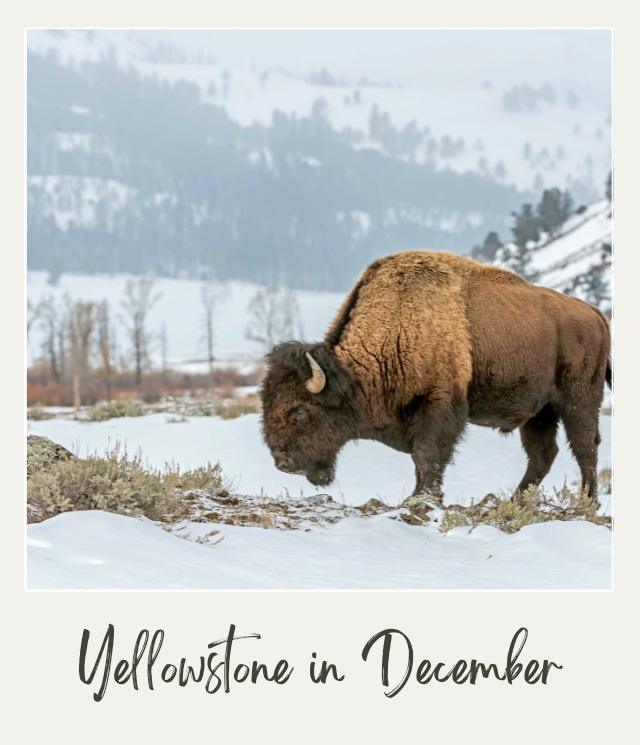
Bison use their massive heads to sweep snow away from buried grasses. You may see frost collect on their coats during very cold mornings.
Elk gather in and around the Northern Range, including near Mammoth and Gardiner. Bighorn sheep are often visible on rocky slopes where snow is thinner.
Coyotes and foxes listen for rodents beneath the snow before pouncing through the surface. Wolves travel widely, and their dark coats can stand out against open white valleys.
Most bears are denned by December, although wildlife behavior is never completely predictable. Continue following bear-safety practices and carry bear spray when traveling outside developed areas.
Winter Wildlife Safety
Cold weather does not make Yellowstone’s animals tame. Bison can run quickly on snow and may charge if people approach too closely, especially during Yellowstone National Park in December.
Never use your vehicle or your body to pressure an animal off the road. If bison block traffic, remain inside and wait for them to move.
Store food securely and keep pets under control where pets are permitted. Dogs are not allowed on most park trails or boardwalks.
What Is Open in Yellowstone in December?
Winter services are limited, and opening dates can change. Do not build an itinerary around a restaurant, lodge, gas station, or visitor center without confirming its current schedule.
Facilities that may operate for at least part of December include:
- Albright Visitor Center at Mammoth Hot Springs
- Mammoth-area lodging and dining
- Old Faithful Snow Lodge and nearby winter services
- Selected warming huts
- Limited fuel stations
- Commercial snowcoach and snowmobile operations
- Lodging, restaurants, and stores in gateway communities
Some winter facilities do not open until around the middle of the month. Weather, snowpack, staffing, maintenance, or operational changes may affect the schedule.
West Yellowstone, Gardiner, Cooke City, and Jackson offer additional services, but business hours may be reduced. Cooke City is small, so confirm fuel and dining availability before depending on it.
Is December a Good Time To Visit Yellowstone?
December is an excellent time to visit if you want snowy scenery, active wildlife, quiet landscapes, and a genuine winter experience.
It is less suitable if you want to drive your own vehicle to every major attraction, hike high-elevation trails, camp in mild weather, or rely on a wide selection of restaurants and services.
Pros
- Very small crowds
- Excellent wildlife watching
- Beautiful snow-covered landscapes
- Dramatic geothermal steam
- Guided snowcoach and snowmobile adventures
- Outstanding winter photography
- Cross-country skiing and snowshoeing
- Convenient access to the Northern Range from Gardiner
Cons
- Extremely cold temperatures
- Most roads closed to private vehicles
- Limited lodging and dining
- Very short daylight hours
- Few developed camping options
- Winter tours can be expensive
- Storms may delay transportation
- Some services do not open until mid-month
Final Thoughts
Visiting Yellowstone National Park in December requires more preparation than a warm-weather trip, but winter reveals a remarkable side of the park. Snow softens the landscape, geothermal steam fills the cold air, and wildlife stands out against open white valleys.
Choose your base carefully, reserve oversnow transportation in advance, and keep your daily plans flexible. With warm clothing and realistic expectations, December can be one of the most peaceful and memorable times to experience Yellowstone.
Deciding when to go to Yellowstone National Park is a very important step in planning your trip, and I hope this guide is helping.
However, as I’m sure you’re very aware, this is just one thing of many to decide. Once you’ve decided the timing of your trip, you still need to make an actual plan.
In fact, the thing that most people ask me about is how to put it all together into an itinerary that makes sense. They decide when they’ll go and maybe even book their flights, but still worry about how to minimize the crowds, what to do – and when – and how to coordinate it all.
To help take away the overwhelm of planning a trip to Yellowstone National Park, I’ve created several super detailed itineraries.
Without them, people often feel stressed about planning their trip. With them, they have the confidence of getting all the info they need in one spot. Plus, there’s flexibility built in, so they can easily adapt them to their own interests and activity levels.
There are 1-, 2-, 3-, and 4- day options for Yellowstone National Park: all with detailed hour-by-hour schedules, including alternatives for different activity and fitness levels, plus trail maps and descriptions, driving instructions, important information, essential tips, and everything else you need to make the most of your time in Yellowstone National Park.
Travel Insurance for Yellowstone National Park
No matter what when you go to Olympic National Park in October, you should definitely get travel insurance. This can protect you not only against medical and emergency repatriation, but can also cover things like trip cancellation, loss and/ or theft of property, etc.
➡️ A great insurance option is Travelex. It has coverage for all you’ll need. You can compare Travel Insurance plans here or get a quote right now:
Have a great trip to Yellowstone no matter when you go!
More Planning Resources for Yellowstone National Park
⭐ Yellowstone National Park Guide
⭐ Yellowstone Itineraries
⭐ 7 Mistakes to Avoid
⭐ How Many Days in Yellowstone National Park?
⭐ Guide To Camping In Yellowstone National Park
⭐ How to Visit Yellowstone in Winter
⭐ Best Things To Do In Yellowstone National Park
⭐ The Best Yellowstone Scenic Drives
⭐ Lamar Valley Scenic Drive
⭐ Best Waterfalls in Yellowstone National Park
⭐ Best Hikes in Yellowstone National Park
⭐ Grand Prismatic Spring Overlook Trail Guide
⭐ Best Time to Visit Yellowstone National Park
⭐ Tips For Visiting Yellowstone National Park
⭐ How To Get To Yellowstone National Park
⭐ All The Airports Near Yellowstone National Park
⭐ The Closest Airport to Yellowstone National Park
⭐ 10 Fun Facts about Yellowstone National Park
⭐ Best Books about Yellowstone National Park
⭐ Vacation Rentals Near Yellowstone National Park
⭐ Yellowstone Packing List
➡️ If you’re also planning to visit the Grand Tetons, read my Guide to Grand Teton National Park and get a detailed Grand Teton itinerary.
If you’re planning to visit Yellowstone National Park in spring, summer or fall, make your planning easy and stress free with a detailed itinerary. I have 1-, 2-, 3- and 4-day itineraries for Yellowstone National Park that include all the park highlights, give you choices based on your preferred activity level, and take all the stress out of planning your trip.
Do you have any thoughts on the best time to travel to Yellowstone? I’d love to hear them. Join my private Facebook group National Parks Collectors and comment and let me know.
If you’re planning to visit Yellowstone National Park in December, Pin It to your Yellowstone National Parks board!
💡 Are you just starting to think about taking a national parks trip? Get Inspiration
‼️ Are you looking for helpful tips for visiting US national parks? Read articles that share useful tips on a range of national-park related issues
💻 Are you starting to plan a trip to Yellowstone National Park? Read my Guide to Yellowstone National Park
📋 Do you want a ready-made super detailed plan for your trip to Yellowstone? Get a detailed 1 – 4-day Yellowstone National Park Itinerary
🛏️ Are you looking for a place to stay in or near Yellowstone National Park? Find a vacation rental near Yellowstone National Park or ⛺ Find a campground inside Yellowstone National Park
💲 Are you ready to book your trip? Use these Planning and Booking Resources
📖 Do you want to read a book about Yellowstone National Park? Check out my Recommended Reading List for Yellowstone National Park
About the Author
James Ian has traveled to 82 countries and all 7 continents. He has visited all of the main national parks in the United States, as well as many national monuments and state parks.
He has rafted through the Grand Canyon; rappelled down slot canyons near Zion and Arches; hiked among the hoodoos in Bryce and the enormous trees in Sequoia; admired the waterfalls in Yosemite and the colored hot springs in Yellowstone; seen moose in Grand Tetons and seals in the Channel Islands, and much more.
I’m a member of the Amazon Services LLC Associates Program. As an Amazon Associate I earn from qualifying purchases.