
November in Glacier National Park is the beginning of the long winter season. Snow settles over the mountains, most park services have closed, and the number of visitors drops dramatically. It is a peaceful and beautiful time to see Glacier, but it requires much more flexibility than a summer visit.
A visit to Glacier National Park in November is best suited to travelers who are comfortable with cold weather, changing road conditions, limited facilities, and self-guided exploration. You will not be able to drive the full Going-to-the-Sun Road or reach many of the park’s famous alpine trails. However, you can enjoy quiet walks near Lake McDonald, photograph snow-covered peaks, look for wildlife, and experience a side of Glacier that most visitors never see.
‼️ If you just want a quick snapshot of my thoughts on when to visit, check out my Best Time to Go to Glacier National Park guide.
🛏️TOP HOTEL PICK: Check availability now
🚘FIND THE CHEAPEST CAR RENTAL: Search Discover Cars for the best deals
✈️FIND THE CHEAPEST FLIGHTS: Search Skyscanner for the best deals
🧳GET TRAVEL INSURANCE: Get insured with Travelex before you go
📱TAKE AN AUDIO TOUR: Buy an audio tour now
Table of Contents
Visiting Glacier National Park in November
Weather in Glacier National Park in November
The weather in Glacier National Park in November is cold and unpredictable. Conditions also vary considerably between the lower valleys and higher elevations.
At lower elevations, daytime temperatures are commonly in the 30s and low 40s°F (approximately 1°C to 6°C). Overnight temperatures frequently fall into the 20s°F (-7°C to -1°C), and colder spells are possible.
Snow can fall throughout the month. Lower elevations may alternate between rain, sleet, and snow, while accumulating snow is much more likely in the mountains. Storms can arrive quickly, occasionally making roads and trails icy or temporarily inaccessible.
November weather can include:
- Cold, clear days with excellent mountain views
- Rain or wet snow around the lower lakes and valleys
- Heavy snow at higher elevations
- Strong winds along the Continental Divide
- Ice on roads, boardwalks, and shaded trails
- Rapidly changing visibility during storms
Check the official National Park Service weather and road information immediately before entering the park. Conditions may change significantly between the morning and afternoon.
Daylight Hours in November
When visiting Glacier National Park in November, daylight is limited. At the beginning of the month, you have roughly ten hours of daylight. By the end of November, that drops to around nine hours.
Following the end of daylight saving time, sunset occurs before 5:00 PM. Plan to finish hikes and scenic drives well before dark, especially when roads or trails may be icy.
Keep a headlamp in your daypack even if you are only planning a short walk. It is easy to underestimate how quickly darkness arrives in the mountains.
Fall Colors in Glacier National Park in November
If you are hoping to see autumn leaves in Glacier National Park in November, most traditional fall foliage has already finished. The aspens and cottonwoods generally lose their leaves during October, particularly after the first strong wind or snowstorm.
However, western larches can sometimes retain their golden needles into early November, especially at lower elevations on the west side of the park. The exact timing changes each year. If autumn has been mild, you may catch the final golden trees around the Lake McDonald Valley before their needles fall.
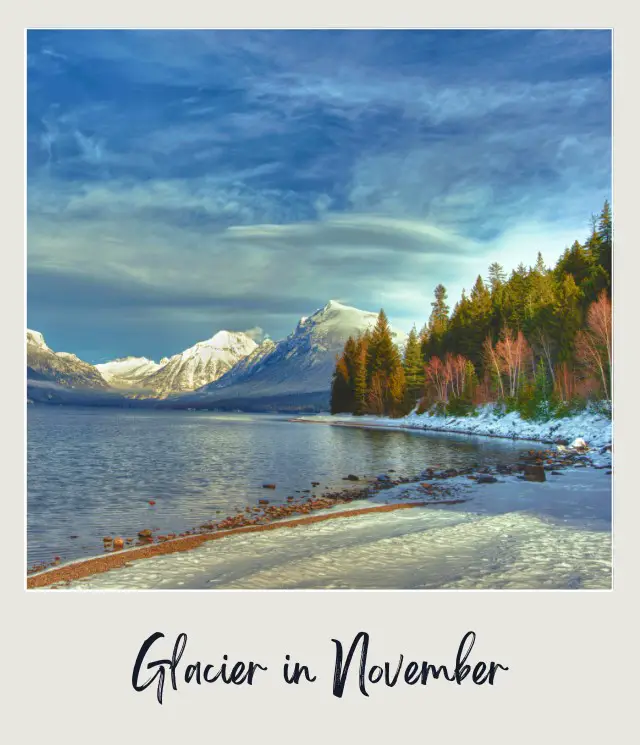
Even without fall foliage, the landscape is incredible. Snow on the surrounding peaks contrasts beautifully with the dark evergreen forests and the deep blue or gray water of Lake McDonald.
Crowds in Glacier National Park in November
Crowds are rarely a concern in Glacier National Park in November. Parking areas that are extremely busy in summer may have only a few vehicles, and you could have an entire lakeshore or lower-elevation trail to yourself.
The quiet makes November appealing, but it also means you should be more self-reliant. There may not be other hikers nearby if you get lost, fall, encounter wildlife, or experience a sudden change in the weather.
Cell service is unreliable in much of Glacier. Tell someone where you are going and when you expect to return, even if you are only planning a relatively short hike.
What’s Open in Glacier National Park in November?
November access is limited and depends heavily on snow, ice, maintenance operations, and temporary closures. Most summer facilities and services are closed.
Here is what you can generally expect.
Park Entrances
When visiting Glacier National Park in November, the West Entrance near West Glacier normally provides the most reliable access. This entrance leads to Apgar Village and the southern end of Lake McDonald.
The St. Mary Entrance may provide limited access on the east side, but the Going-to-the-Sun Road closes to through traffic. Snow and wind can also make east-side conditions much harsher than those around Apgar.
The roads into Many Glacier and Two Medicine are not reliable sightseeing routes in November. They may be unplowed, gated, icy, or inaccessible because of snow. Do not build your itinerary around reaching either valley without confirming current conditions.
The North Fork area is particularly remote. Roads leading toward Polebridge, Bowman Lake, and Kintla Lake are narrow, rough, and generally not maintained for winter travel. Attempting them after snow can be dangerous.
Always consult the park’s current road status map before setting out.
Going-to-the-Sun Road
You cannot drive the entire Going-to-the-Sun Road when visiting Glacier National Park in November. The alpine section across Logan Pass closes for winter, usually well before the month begins.
On the west side, the lower road from West Glacier through Apgar and along Lake McDonald may remain open to vehicles as far as the seasonal gate. The precise closure point can change according to weather and plowing operations.
On the east side, only a short lower section may be open from St. Mary. The road beyond the winter gate is not maintained for regular vehicle travel.
Do not drive around a closed gate or park in front of one. Rangers and road crews still need access, even when the area appears deserted.
Scenic Drives
Although the complete Going-to-the-Sun Road is unavailable, you can still enjoy the open lower section around Apgar and Lake McDonald. The views across the lake toward snow-covered mountains can be beautiful on a clear day.
US Highway 2 runs along the southern edge of the park and generally remains open throughout the year. It can provide impressive views near the Middle Fork of the Flathead River, but winter driving conditions are possible.
Many smaller park roads are not plowed. Carry tire chains if required, make sure your vehicle has suitable winter tires, and check Montana road conditions before traveling between communities.
Glacier Hiking Trails in November
Trails do not necessarily close simply because winter has arrived, but access and hiking conditions change dramatically.
Lower-elevation routes may be wet, muddy, icy, or lightly snow-covered. Higher trails can have deep snow, hidden ice, avalanche exposure, and difficult route-finding conditions.
Possible lower-elevation options include:
- Walks along the Lake McDonald shoreline
- Short trails around Apgar
- Forest walks accessible from an open section of the Going-to-the-Sun Road
- Rocky Point, if the approach and trail conditions are safe
- Sections of trails near the park boundary or lower valleys
Access to the Trail of the Cedars and Avalanche Lake depends on the location of the seasonal road closure. Even when hikers are permitted beyond a vehicle gate, reaching the trailhead may require several additional miles of walking.
Popular alpine hikes such as the Highline Trail, Hidden Lake Overlook, Grinnell Glacier, Iceberg Lake, and Siyeh Pass should not be treated as conventional day hikes at this time of year. Snow, avalanche terrain, closed roads, and limited daylight make these routes unsuitable for most November visitors.
Before starting any hike:
- Check the current weather and trail conditions.
- Confirm that the trailhead is accessible.
- Ask whether the route passes through avalanche terrain.
- Carry a paper map and navigation device.
- Turn around if snow, ice, or visibility makes the route unsafe.
Microspikes can help on packed snow and relatively level ice, but they do not make an avalanche-prone or steep alpine route safe.
➡️ Read my guide to the best hikes in Glacier National Park for an overview of the park’s trails, keeping in mind that many are primarily summer hikes.
Visitor Centers
Most Glacier visitor centers are closed in November.
The Logan Pass Visitor Center is inaccessible by vehicle after the alpine section of the Going-to-the-Sun Road closes. The St. Mary Visitor Center is also normally closed for the season.
The Apgar Visitor Center may have limited winter availability, but days and hours can change. Do not assume that it will be open during your visit.
Park headquarters near West Glacier is generally the best place to check for available ranger assistance during normal weekday business hours. Confirm current operating hours on the National Park Service website before going.
Ranger Programs
Regular summer ranger programs have ended by November. Guided walks, evening talks, and other scheduled activities are generally unavailable.
This means you will need to plan a self-guided visit.
Check the park calendar before your trip in case a special event or limited program is scheduled.
Campgrounds
Developed campgrounds have ended their regular operating seasons by November. Water, flush toilets, dump stations, and other summer services are unavailable.
The park may permit primitive winter camping in designated areas, typically at Apgar and St. Mary. Winter camping arrangements, accessible sites, fees, and registration procedures can change, so confirm the current details on the official Glacier camping page.
If winter camping is available, expect:
- No potable water
- No flush toilets
- No campground hosts
- No firewood sales
- Limited or no trash service
- Unplowed or partially plowed parking areas
- Freezing temperatures and possible heavy snow
Bring all the water you need, pack out your trash, and use a sleeping bag rated well below the predicted overnight temperature. A standard warm-weather tent and sleeping bag will not be sufficient if temperatures drop sharply.
Lodging and Food
All park lodges are closed for the season. You will also find few, if any, restaurants, stores, gas stations, or other visitor services operating inside the park.
West Glacier businesses generally have limited winter hours, and some close completely. Columbia Falls, Kalispell, and Whitefish provide more dependable choices for accommodations, groceries, restaurants, and fuel.
Staying outside the park is the easiest option for most people visiting Glacier National Park in November. It gives you a warm base and makes it easier to change your plans if a storm limits park access.
➡️ Read my guide to the best places to stay near Glacier National Park.
Restrooms and Drinking Water
Do not assume that restrooms or drinking-water stations will be available. Most seasonal facilities are winterized, and services that remain open may be affected by maintenance or weather.
Carry sufficient drinking water for the entire day. It is also smart to keep toilet paper, hand sanitizer, and a sealable trash bag in your vehicle.
Best Things to Do in Glacier National Park in November
A November trip is not about checking every famous attraction off a list. Focus on accessible lower-elevation areas, leave room for changing conditions, and choose activities that do not depend on reaching the alpine parts of the park.
Explore Lake McDonald
Lake McDonald is one of the most accessible places in Glacier National Park in November. Begin at Apgar and walk along the lakeshore, where you can enjoy views toward the mountains without committing to a long hike.
The water is often calmest early in the day. On a clear morning, the snow-covered peaks may reflect in the lake, creating one of the best November photography opportunities in the park.
The shoreline rocks can become icy, so watch your footing and stay back from the cold water.
Drive the Open Section of Going-to-the-Sun Road
Drive as far as the seasonal gate allows, stopping at open pullouts along Lake McDonald. The exact turnaround point varies, so check the road status before leaving your accommodation.
Traffic is usually light, but do not become complacent. Shaded curves may remain icy even when exposed sections of the road look dry.
Take a Lower-Elevation Walk
A short forest or lakeshore walk can be incredible after fresh snow. Choose a route with straightforward navigation and avoid steep terrain unless you have appropriate winter experience.
November is not the month to push ahead simply because a trail appears on a summer hiking list. If the route becomes difficult to follow or ice makes travel unsafe, turn around.
Look for Wildlife
Mule deer and white-tailed deer may appear around lower valleys, roadsides, and forest edges. Elk can also be seen in and around the park, while bighorn sheep are more commonly associated with rocky terrain on the east side.
Bears may still be active in November. A cold day or fresh snow does not guarantee that every bear has entered its den.
Carry bear spray where you can reach it immediately, make noise on trails, and never approach or feed wildlife. Maintain at least 100 yards from bears and wolves and at least 25 yards from other animals.
Photograph the Early Winter Landscape
November provides very different photography conditions from Glacier’s main visitor season. Snow highlights the mountain ridges, low-angle light adds texture to the landscape, and quiet lakeshores make it easier to compose images without crowds.
Good subjects include:
- Snow-covered peaks above Lake McDonald
- Reflections from the Apgar shoreline
- Frost-covered plants and fallen leaves
- Fresh animal tracks in the snow
- Clouds moving through the mountains
- Golden larches, if needles remain in early November
- Colorful Lake McDonald stones beneath clear, shallow water
Keep spare camera batteries in an inside pocket because cold weather drains them quickly. A lens cloth is also useful when moving between a warm vehicle and cold outdoor air.
Enjoy Stargazing
Glacier’s limited artificial light can create excellent stargazing conditions on clear November nights. However, temperatures fall quickly after sunset, and roads or parking areas may become icy.
Choose an accessible location near your vehicle rather than walking far down an unfamiliar trail. Pack insulated boots, gloves, a warm drink, and a headlamp with a red-light setting.
Wildlife Viewing in November
Wildlife can be easier to notice once leaves have fallen and visitor numbers decrease, but sightings are never guaranteed. Dawn and dusk are often productive times around open meadows, forest edges, and quiet roads.
November also brings additional safety considerations. Deer and other animals may step onto roads with little warning, particularly in low light. Drive slowly and scan both sides of the road.
Use binoculars or a telephoto lens rather than moving closer. If an animal changes direction, stops feeding, watches you closely, or moves away, you are too close.
Never leave food, coolers, trash, or scented items unattended. Follow all posted food-storage rules, including when camping or stopping for a picnic.
Is November a Good Time to Visit Glacier National Park?
Visiting Glacier National Park in November can be an amazing experience if you want solitude and are happy to explore a small, accessible part of the park. It is not a good choice if your priority is driving the entire Going-to-the-Sun Road, staying in a historic park lodge, or hiking Glacier’s iconic alpine trails.
The key is to match your expectations to the season. Think of this as a quiet early-winter getaway rather than a conventional Glacier sightseeing trip.
Pros
- Very few visitors
- Easier parking in accessible areas
- Beautiful snow-covered mountain scenery
- Excellent conditions for peaceful landscape photography
- No vehicle reservation generally required
- Lower accommodation prices may be available outside the park
- Good opportunities for short, quiet walks
Cons
- Going-to-the-Sun Road is closed across the mountains
- Many popular valleys and trailheads are inaccessible
- Park lodges and most visitor facilities are closed
- Ranger programs are generally unavailable
- Hiking conditions may include mud, snow, and ice
- Daylight hours are short
- Winter storms can disrupt plans
- Dining and shopping options near the entrances are limited
Final Thoughts
A trip to Glacier National Park in November gives you an incredible opportunity to experience Lake McDonald, snow-covered mountains, and quiet forests without the usual crowds. However, the limited road access, closed facilities, short days, and unpredictable weather mean you need realistic expectations.
Base yourself near the west side, check current conditions every morning, and focus on accessible lower-elevation activities. Bring winter clothing, food, water, emergency driving supplies, and a flexible plan.
November is not the right time to see every iconic Glacier attraction. But if you are comfortable trading extensive access for solitude and early-winter scenery, it can be an amazing time to experience a peaceful side of the park.
Deciding when to go to Glacier National Park for is a very important step in planning your trip, and I hope this guide is helping.
However, as I’m sure you’re very aware, this is just one thing of many to decide. Once you’ve decided the timing of your trip, you still need to make an actual plan.
In fact, the thing that most people ask me about is how to put it all together into an itinerary that makes sense. They decide when they’ll go and maybe even book their flights, but still worry about how to minimize the crowds, what to do – and when – and how to coordinate it all.
To help take away the overwhelm of planning a trip to Glacier National Park, I’ve created several super detailed itineraries.
Without them, people often feel stressed about planning their trip. With them, they have the confidence of getting all the info they need in one spot. Plus, there’s flexibility built in, so they can easily adapt them to their own interests and activity levels.
There are 1, 2, 3, and 4-5 – day options: all with detailed hour-by-hour schedules, including alternatives for different activity and fitness levels, plus trail maps and descriptions, driving instructions, important information, essential tips, and everything else you need to make the most of your time in Glacier National Park.
Travel Insurance for Glacier National Park
No matter when you go to Glacier National Park, you should definitely get travel insurance. This can protect you not only against medical and emergency repatriation, but can also cover things like trip cancellation, loss and/ or theft of property, etc.
➡️ A great insurance option is Travelex. It has coverage for all you’ll need. You can compare Travel Insurance plans here or get a quote right now:
Enjoy Glacier National Park!
Additional Planning Resources for Glacier National Park
⭐ Planning A Trip to Glacier National Park: 7 Mistakes to Avoid
⭐ Guide to Glacier National Park Ticketed Entry
⭐ The Best Hikes in Glacier National Park
⭐ How to Get to Glacier National Park
⭐ When is The Best Time To Visit Glacier National Park?
⭐ 15 Tips For Visiting Glacier National Park
⭐ The Airports Near Glacier National Park
⭐ The Closest Airport To Glacier National Park
⭐ 10 Fun Facts About Glacier National Park
What do you think is the best month to visit Glacier National Park? Join my private Facebook group National Parks Collectors and comment and let me know (you can also pick up extra planning tips, share your photos and stories with other national park lovers and more).
If you liked this article about Glacier National Park in November, Pin It to your Glacier National Park board!
💡 Are you just starting to think about taking a national parks trip? Get Inspiration
‼️ Are you looking for helpful tips for visiting US national parks? Read articles that share useful tips on a range of national-park related issues
💻 Are you starting to plan a trip to Glacier National Park? Read my Glacier National Park Guide
📋 Do you want a ready-made super detailed plan for your trip to Glacier? Get a detailed 1 – 5-day Glacier National Park Itinerary
💲 Are you ready to book your trip? Use these Planning and Booking Resources
📖 Do you want to read a book about US national parks? Check out my Recommended Reading Lists
About the Author
James Ian is a national park, camping and hiking expert.
He has dedicated his life to travel, visiting more than 80 countries, all 7 continents and most of the national parks in the United States. With over 35 years experience in the travel industry, James has worked on cruise ships, at resorts and hotels, and as a travel planner who’s helped hundreds of people plan successful trips to US national parks.
Based on his experience visiting our national parks multiple times, in-depth research and expertise as a travel planner, James has published detailed itineraries for many of the major national parks in the US. These itineraries, as well as in-depth park guides, and other resources will help you have your own incredible trip to US national parks without stress and hassle.
As a national park expert, James has contributed to many publications, including USA Today, Newsweek, Time Business News, Savoteur, Best Trip, and Wired.
I’m a member of the Amazon Services LLC Associates Program. As an Amazon Associate I earn from qualifying purchases.