
Let’s face it, most people go to the national parks in summer and many of the parks are at their best in the summer, but summer, can be brutal in many of the national parks. So if you go to the national parks in the summer and you aren’t packing these seven things, then you’re missing out.
I promise that these things will change your life. They changed mine.
Packing for national parks trips isn’t easy, and packing for a summer trip brings its own challenges.
So, I’m going to share with you seven things that I never even knew about when I first started visiting the national parks. And now I can’t live without them. They literally changed my life, and I’ll tell you why.
By sharing these things with you, I’m going to help you have even better summer national parks trips than you already have.
See these 7 must-pack items for summer national park trips on video:

🔔 You can also watch this video on YouTube directly (opens in new tab).
🎙️ Or listen as a podcast:
Table of Contents
Essentials for Hiking
The first three items on my summer vacation packing list for the national parks are about hiking. So, if you’re not a hiker, you can skip these three and go straight to number four.
1. Cooling Neck Towels
I read about these online and I was extremely skeptical when I first did. But I was wrong.
Cooling neck towels are basically like a small cloth that you wet and then you drape it around your neck and it stays cool and wet for a couple of hours at least.

So imagine hiking in the heat, but your neck is cool, not just wet. But actually cool. It really cools your whole body down.
I first tried this when I was hiking in Zion in the summer. It was the only time that I could go and I wanted to do the hike to Observation Point, which is one of my favorite hikes. Well, actually it is my favorite hike in the park, but there’s very little shade, and it was well over a hundred degrees, so I was kind of worried about the heat and I saw these and I thought, I’m going to give them a go.
So I bought a pack of three and I wet them and I put them in a Ziploc bag so that they stayed wet and I wore one and it was a mazing. Like it was not just wet, but cool.
And it just cooled down my whole body and it lasted for almost three hours. And then when it was dry, I got the next one out of my Ziploc bag and draped it around my neck. It was amazing. I don’t know how they work, but they work.
>> Click here to get some Cooling Neck Towels on Amazon
2. Hiking Umbrella
A hiking umbrella is also something that I’d seen online. and I was actually looking to do a rim-to-rim hike in Grand Canyon in one day, which is not really recommended in the end I didn’t do it, but I ended up hiking North Kaibab Trail down to Roaring Springs. It was the first week of August. So, it was very, very hot I was looking for ways to stay cool and be safe in addition to my cooling neck towel.
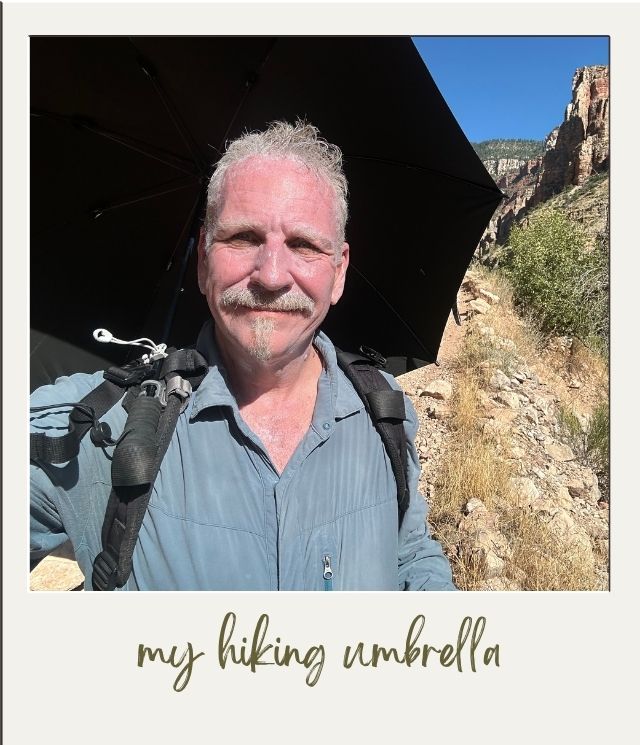
I saw these and I gave it a try, and it was really incredible. It was about. 10 to 20 degrees cooler under my umbrella than without it. Now a hat works to some extent, but imagine having this built in shade and it just travels around with you all of the time. Really, really amazing.
There’s a couple of different versions. There are ones that collapse completely, like a tiny little umbrella. And there’s ones that stay longer. I recommend the ones that don’t collapse because they’re stronger.
They come with an attachment that you can hook onto your day pack, which is good because then you’ve got your hands free to do other things. So, I recommend that.
They’re very light and they have a reflective thing inside, so they’re designed to stay cool while you hike.
The one downside I found is that after hiking for multiple hours, that it did pull on my shoulder a little bit. I did feel it after a long time, but it was still totally worth it in my opinion, because it really did stay much cooler. You want to look at ones that don’t weigh very much.
The other thing to be aware of or conscious of is that it does take up more space than your body because it’s wider, obviously. So you need to just be very respectful when you’re passing people on the trail. Make sure that you’re not poking them in the eye.
If you’re hiking on a trail like the Bright Angel Trail, that has mules on it or trails in Bryce Canyon that are also horse trails, for example. Then I would put it down at that time so that you’re not spooking the animals. But in general, I highly recommend it.
If I’m on a super crowded, narrow trail, I won’t bother. But if I’m on a trail that’s not that busy and it’s not shady, then I take it all the time now. It’s really, really incredible. It really does make a difference.
>> Click here to get a Hiking Umbrella on Amazon
3. Electrolytes
The other thing to take if you’re hiking in the summer are electrolytes.

Now, of course, you need to stay well hydrated, but there’s actually a thing called hyponatremia. This is over hydration, not under hydration. And it’s potentially life threatening and it’s when you’ve drunk so much, but that you haven’t replenished the sodium and the electrolytes in your body.
I found this when I was researching the rim-to-rim trail too, and I got a little scared about it because, it’s easy enough to hydrate, but you want to make sure that you are replacing the electrolytes and the sodium, and you can do that through salty snacks. Of course you should always do that.
But now I’ve started to put electrolytes in my water. It’s a powder. You put it in your water. It’s easy to drink. I alternate – one bottle of water with one mottles of water with electrolytes in it.
You need to find the right balance, because everyone has a little bit of a different balance. And you should definitely experiment on shorter, easier hikes than if you’re doing a super long, difficult hike in the heat of the summer.
But when I’m hiking in the heat, then I always do this now.
>> Click here to get these Electrolytes on Amazon
4. National Parks Passes
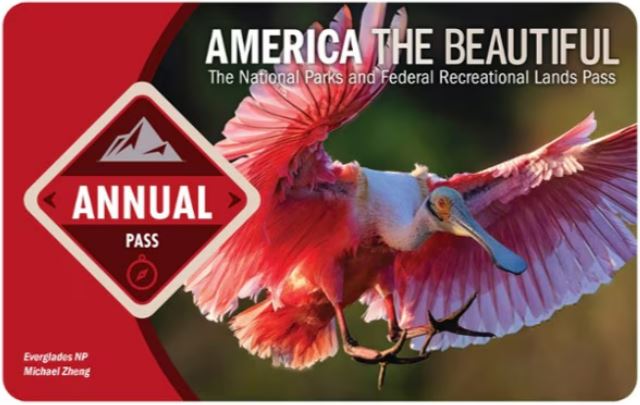
The next thing that I recommend and people can overlook this, is a park’s pass.
You can always pay the entrance fee at the park when you go through the gate, assuming that it’s open. But if you are planning to visit several national parks a year, or if you’re in a certain categories of people, then it’s actually cheaper to buy a particular pass.
➡️ See my Guide to US National Parks Passes for more details
The main pass that you can get if you’re a US citizen or resident is the America the Beautiful pass. And this allows you to enter, not only any of the national park sites, but also the National Forests. There’s the Bureau of Land Management, the Bureau of Reclamation and Army Corps of Engineers, the Fish and Wildlife Service – that’s over 2,000 sites and it’s valid for a year.
You can buy them at the entrance station to parks or you can buy them online, which I recommend.
If you are a non-resident, so if you’re an international visitor, then there is a different version, that is more expensive – also mentioned in the guide written on my website.
There’s also a non-resident fee that’s in addition to the regular entrance fees for some of the most popular national parks in the country. So, you do need to be aware of that if you’re visiting from abroad.
Other categories of people who are eligible for special passes are veterans and military members, and gold star family members.
There are also passes for seniors, and if you’re a senior, then you can get a one year pass or a lifetime pass. It’s valid for US citizens or permanent residents who are 62 years or older, and it does allow up to three other people in your vehicle to enter. So, I highly recommend getting the lifetime pass if you are eligible and intend to visit more than a couple of parks within the rest of your life, basically.
There are also passes for persons with disabilities. And then also if you’re a fourth grader, there’s a special program that will give fourth graders free national parks passes.
Now fourth graders are actually free anyway. Anyone under the age of 16 is, but it will give everyone in their vehicle free access for the year. So if you have a fourth grader or the homeschool equivalent, then I recommend looking into the Every Kid Outdoors program.
➡️ See my Guide to US National Parks Passes for more details
So take your pass with you. Even if you just decide to get a pass for the National Park itself that you’re visiting, you can, for most of them actually go to recreation.gov, the official website for the National Park Service and buy the pass in advance online and then just take a copy with you and you can often fast track the lines by doing that. So I recommend doing that if you don’t want to invest in another pass.
Essentials for the Car
The last three items on my list are for national park road trips or fly and drive vacations because these are things to have in your vehicle.
5. Collapsible Water Container for Your Car
You can usually refill your water bottle at visitor centers, or sometimes at some key trailheads in the national parks, but not always.
And for many of the parks, you don’t necessarily want to go back once you’re deep in the park. Arches, for example, once you’ve passed the visitors center, you’re along the scenic drive. You don’t want to have to go back to fill up your water bottle.

So something that I recommend is to keep a large water container in your vehicle. And that way you can use that to top up your individual water bottles so that you can safely go on hikes and you can stay well hydrated throughout your day in the park.
>> Click here to see this Water Container on Amazon
6. Audio Tours
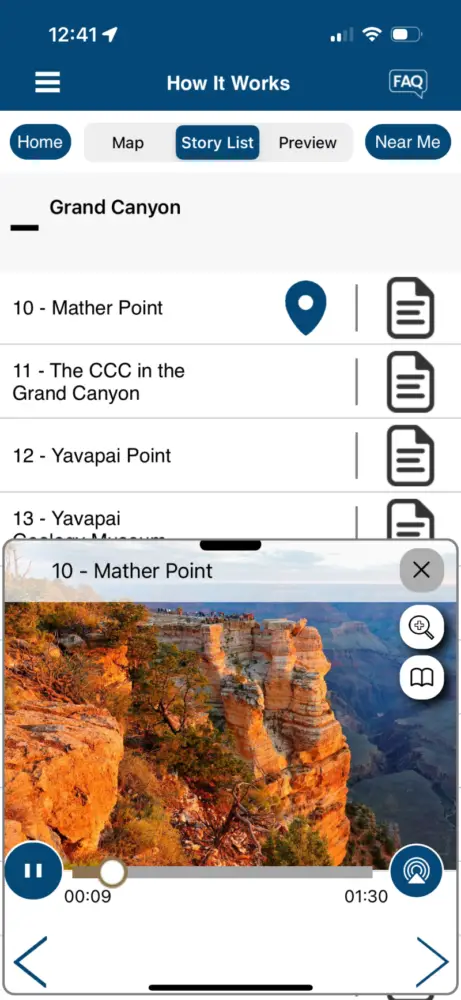
This is not related to summer particularly, but I really got into these. There’s a few different companies that do them. I really like the Action Tour Guide ones, but they’re very similar.
➡️ Read my Guide to National Park Audio Tours for more details
You go to their website, you can often get bundles, which are often better if you’re planning to go to several national parks, but you can get them for individual parks.
And then once you’ve booked the tour, you get a text or an email with the instructions and a link to download the app along with the passcode.
So you download the app and I recommend doing that before you go, while you have good Wi-Fi.
When you’re there, you actually don’t need to use Wi-Fi to play the tour. Some of them will have multiple versions or different versions for different entrances of the tour. You choose the one that’s applicable for your particular itinerary.
And then when you’re in the park, it’s interesting, it actually just starts playing automatically once you reach a particular point in the park. It reads using the GPS in your phone. So you do need to have your phone. Your phone needs to be well charged, but you don’t need cell service. It doesn’t rely on that. It will just start to play automatically as you get to a particular point.
And it gives you lots of really interesting information about the park, which I really like. About the history, about the geology, et cetera. It’s kind of the best of both worlds. You get a tour guide, but you’re in your own vehicle, you’re going at your own pace. You’re getting the information, but it’s still your trip and it’s very flexible.
So I recommend them. I really got into them and I get them for all my trips now.
➡️ Read my Guide to National Park Audio Tours for more details
7. Foldable Cooler

I always fly and then pick up a rental car and drive. So this is perfect in this situation. If you’ve driven on a road trip all the way from your home, you may not need this. You can have a much bigger cooler that you can take the whole way.
But what I used to do, I would fly, I would get somewhere, I would want to have a cooler in the car because I want to pack a picnic lunch. I want to keep water cool. I want to buy breakfast and have it the next day on the trail, for example, because I’m often up early in the parks.
So I would fly somewhere, buy a disposable cooler, use it, and then throw it away at the end, which is bad, right? It’s expensive, I’m wasting money. It’s bad for the environment, it was just bad. But I couldn’t pack a whole cooler in my luggage on the plane.
Then I discovered collapsible coolers. They’re so cool because it’s fabric. It collapses into a flat thing so it fits in my bag on the plane, and then it constructs into a three dimensional box that’s insulated and designed to stay cool. I use it and then at the end of the trip, collapse it back and it’s flat again.
So it was a game changer. It’s much better for the environment, much better on my wallet. If you are doing this, if you do a fly and drive vacation and you’ve always wanted a cooler in your vehicle, but you don’t want to carry a big, bulky thing on the plane, this is just amazing.
>> Click here to see this Foldable Cooler on REI
Do you have any other thing to include on your national parks summer packing list that’s not here? Join my private Facebook group National Parks Collectors and comment and let me know (you can also pick up extra planning tips, share your photos and stories with other national park lovers and more).
If you found this summer packing list helpful, Pin It to your Packing Lists and National Parks Pinterest board!
More Packing Lists
🥾 Day Hikes
👣 Hiking Gear for Beginner Hikers
🏔️ Winter Hikes
⛺ Tent Camping
🌲 National Parks Essentials
❄️ Winter Vacations
🚗 Road Trips
About the Author
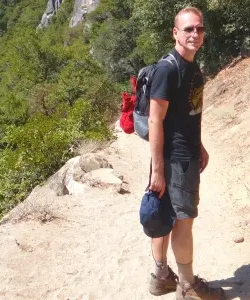
James Ian is a national park, camping and hiking expert.
He has dedicated his life to travel, visiting more than 80 countries, all 7 continents and most of the national parks in the United States. With over 35 years experience in the travel industry, James has worked on cruise ships, at resorts and hotels, and as a travel planner who’s helped hundreds of people plan successful trips to US national parks.
Based on his experience visiting our national parks multiple times, in-depth research and expertise as a travel planner, James has published detailed itineraries for many of the major national parks in the US. These itineraries, as well as in-depth park guides, and other resources will help you have your own incredible trip to US national parks without stress and hassle.
As a national park expert, James has contributed to many publications, including USA Today, Newsweek, Time Business News, Savoteur, Best Trip, and Wired.
I’m a member of the Amazon Services LLC Associates Program. As an Amazon Associate I earn from qualifying purchases.